



Brokers and carriers have invested heavily in all kinds of technology, from CRMs to AMSs to benefits administration platforms to quoting tools. Who wouldn’t if you were promised features that could “10x your workflows”?
The problem is that these tools are just point solutions. They only help with marketing, they only help with quoting, they only help with ops, they only help with compliance. And none of them talk to each other.
Ironically, that means much of brokers’ day-to-day work is done in emails, spreadsheets, and portals, outside of the technology supposedly designed to support it. What brokers really need isn’t another tool that shows them what’s left to do or what’s already been done. They need a place to do the work itself.
Below, we dig into where today’s broker technology stack falls short, why these tools were never built for placement collaboration, and how a Benefits Placement System (BPS) makes placement faster and more efficient—without disrupting your existing systems.
The tools gap behind everyday placement friction
In a recent survey of 330+ brokers, we found that brokers spend close to a full workweek (39 hours per employer group) just getting through the mechanics of placement. Every core quoting task (renewals, RFPs, negotiations, spreadsheeting, communications) now takes at least 6 hours, sometimes closer to 10.
It makes sense when you think about how many different people are involved in the back and forth of quoting, analysis, and presentation—not just brokers and carriers, but client stakeholders, too. Without a shared place to do the work, every handoff is manual. Not only does that slow things down, it introduces risk: decisions can get made on outdated or inaccurate information.
With more clients wanting to go to market than ever—The Baldwin Group, for example, reported that two-thirds of their clients wanted to run a full RFP in 2025—that friction chips away at the quality of advice brokers are there to give. Brokers have either tried to adapt existing processes only to hit their limit, or they haven’t made changes to keep pace with growing volume and complexity.
Throwing more bodies at the problem doesn’t seem to help either. Brokers consistently say that the tasks that consume the most hours are the ones they need the most help with. In our survey, large and mid-size firms reported the highest total time burden per employer group.
This isn't a people problem, it’s a process problem.
Why existing tools were never built for placement collaboration
If coordination and collaboration is where brokers lose the most time, why hasn’t the existing tech stack solved it? There’s a short answer here: none of the tools support benefits placement end-to-end.
- AMS platforms track policies and store client data. They don’t have shared execution functionality.
- Benefits administration tools are meant for the post-sale side: enrollment, eligibility, compliance.
- Carrier tools are optimized for carrier workflows, not broker-carrier collaboration.
- CRMs manage relationships. There’s no insight into the work happening inside an active placement.
Brokers aren’t short on systems of record. What’s missing is a system of action, a place where brokers, carriers, and everyone in between can do the actual work of benefits placement in real time.
Introducing the missing link: the Benefits Placement System (BPS)
A Benefits Placement System is a shared system of action built to accommodate the full scope and key players of the benefits placement process.
A BPS is where brokers and carriers get work done together—quoting, analysis, data normalization, presentation are all in one, centralized, accessible place. And because everyone is operating in the same shared location, there’s built-in accountability around accuracy, speed, and outcomes.
A BPS doesn’t replace your AMS, your ben admin platform, or your CRM. It fills the gaps they weren’t built to cover. And because it feeds clean data back into your existing systems, a BPS ends up making the stack you have even more useful.
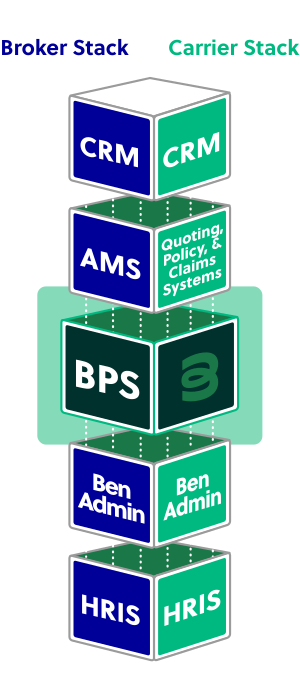
How a shared system of action changes broker & carrier collaboration
These days, most broker-carrier collaboration runs through email. A carrier submits a quote as an attachment, a broker replies with questions, the carrier sends a revised version. Straightforward enough—until someone ccs two more colleagues who need context, and the chain snowballs from there. 13 threads deep, nobody’s 100% sure which quote is final.
Multiply that runaround by the tens or even hundreds of clients a broker supports and it’s almost impossible not to see a negative impact on quality.
As Justin Elmore, Senior Director of Client Experience for Employee Benefits at The Baldwin Group emphasizes:
A BPS eliminates that context switching by giving both parties a shared workspace. Carriers submit directly into the system, and brokers review, compare, and follow up without switching tools or tracking down the latest file. Both sides can see what’s been submitted and what’s outstanding and can work together to get things over the finish line.
It’s built for the real complexity of benefits placement
Benefits placement involves dozens of workflows, each with slight nuances based on the unique needs of every client.
Nicole Negvesky, National Managing Director of Employee Benefits at The Baldwin Group explains:
That kind of variability across plan designs, product mixes, and employee populations is exactly what a BPS is built to handle. It’s designed to work the way brokers, carriers, and general agents actually work so they’re not wasting time with workarounds or forcing their process into someone else’s system.
It fits seamlessly into the tools brokers and carriers already use
There’s no rip and replace with a BPS. It plugs directly into your current toolset. With native integrations to popular CRMs, AMSs, benefits administration platforms, and carrier quoting tools, you don’t have to copy/paste data or wait on a technical team to pull reports.
When a quote is finalized, that information flows into enrollment, compliance, and other client management workflows without any manual intervention. With a BPS, the systems you already have get better data faster, no extra work on your end.
It enables smarter placement through efficiency and intelligence
So much of a broker’s day is spent doing tedious, repetitive tasks. That work isn’t just unpleasant, it’s taking valuable time away from clients. And it really never stops.
As Deanna Beatty, Benefits Processor at Scott Insurance explains:
“There’s really no slow season for our brokers. When you’re working your client base throughout the year, there are so many triggers and milestones you have to think about, so you have to systematize as much as you can.
A BPS uses AI to automate the tasks that consume hours during placement—not just spreadsheeting, but identifying new plans clients are eligible for and building presentations—and make them more accurate in the process. That way, brokers can be the proactive advisors their clients expect, instead of scrambling just to get the basics done.
Why BPS adoption is accelerating now
Clients expect faster turnarounds, clearer recommendations, and more transparency into how decisions get made. And there’s no way brokers can deliver on that speed and quality without modern broker and carrier tools.
As Wayne Bowling, Executive Vice President of Employee Benefits at CAC Agency, puts it:
Hannah’s point gets at something our survey data reinforced: brokers are struggling because the most demanding work happens at the exact moment their tools offer the least support.
Brokerages that adopt a BPS don’t have to change the way they work—they can remove the friction from the work they already do. Plus, the visibility they gain (how carriers are responding, where bottlenecks form, how long each stage actually takes) can help them decide which products to lead with, which carriers to prioritize, and how to advise clients with confidence.
Same work, better results
A Benefits Placement System doesn’t force brokers to overhaul their process, it fits right in. And it makes everything downstream (analysis, evaluation, presentations, post-sale implementation) easier, faster, more accurate.
When brokers aren’t spending their days formatting carrier data, building side-by-side comparisons, and chasing down information, they finally have the headspace to think critically about what they’re recommending, not rush to get proposals in front of clients.
It's time your tools catch up to the way modern brokers work. Get a demo of ThreeFlow.


JUMP TO SECTION
 How will this change the way we work?
Does it fit how we work today?
How does this platform protect my clients, my data, and my reputation?
Who is using your platform and how?
Will this software grow with us?
What truly sets this platform apart?
How does the pricing model align with our revenue model?
What happens after go-live?
How does the platform use AI right now?
How will this change the way we work?
Does it fit how we work today?
How does this platform protect my clients, my data, and my reputation?
Who is using your platform and how?
Will this software grow with us?
What truly sets this platform apart?
How does the pricing model align with our revenue model?
What happens after go-live?
How does the platform use AI right now?

%20(1).avif)


.jpg)


