


As a broker, you have the most control over the things you do solo: spreadsheeting, keeping track of renewals, researching new plan ideas, helping clients implement. But there's so much you don't have control over—when carriers return quotes, when general agents flag underwriting issues, or when a client changes direction mid-cycle.
Coordinating those moving parts is hard, and it gets even harder when there’s no one place to track it. The exact wording from the carrier that you want to send to your client might be buried in a 20-email long thread. An updated quote with a critical rate change might be sitting in a portal you forgot to check until the last minute.
That’s a recipe for mistakes, particularly because clients expect quote comparisons and plan changes to happen quickly—and brokers are handling tens, even hundreds of clients at a time. To support that kind of workload, they need a system that allows them to collaborate alongside carriers, GAs, and internal teams, not just record information after the fact.
Below, we take a closer look at the tools brokers already use, what a shared system of action actually looks like, and why it’s becoming essential to how brokers operate.
Brokers already have plenty of tools—just not one built for action
Brokers aren’t short on technology. They’ve got CRMs to manage client relationships, AMS as their system of record to organize their book of business, and benefits admin platforms to manage the benefits plans they place. Each serves a clear purpose and plays an essential role in the placement process.
But, and this is a big but, those tools are designed to record outcomes. Not to run placement in real time.
And considering the amount of broker-carrier-client collaboration that goes into benefits placement, that’s a huge gap—one that’s adding time to brokers’ days. Our latest State of Benefits Placement report showed brokers spend close to a full workweek (39 hours per employer group) on the mechanics of placement.
What a “system of action” really means in benefits placement
Unlike systems of record (think: AMSs, CRMs), systems of action enable people to collaborate, make decisions, and move work forward in real time. In other words, they support the “during” phase of work, not just the result.
In the context of benefits placement, that means brokers and carriers work from a unified system, sharing data and getting work done together, whether it’s:
- Quoting
- Analysis
- Data normalization
- Presentation
Because brokers and carriers are working from the same place, there’s some joint accountability: they maintain accuracy, speed, and outcomes together.
Why benefits placement has been missing a system of action
Placement sits at a bit of an awkward spot in the technology landscape. It’s a sort of a liminal space: there’s data to be collected and analyzed, but that data is not “final” enough to be saved in a system of record.
Quotes arrive from different carriers in different formats and need to be standardized before they can even be compared. Multiple stakeholders need to weigh in, carriers need to respond to that feedback. Brokers need to reconcile whatever comes back against what the client asked for.
It’s an iterative process, dependent on people who aren’t sitting in the same room or using the same tools. Yet it all needs to get done. And without a shared system, emails and spreadsheets are the best brokers can do.
The cost of not having a shared system of action
That patchwork setup can hold together when you’re managing a handful of clients. At scale, not so much.
Placement cycles take longer
Especially during busy seasons. When every update requires a manual handoff, timelines stretch out. Our data shows every core quoting task now takes at least 6 hours. That holds true across all roles, regions, company sizes, and revenues.
Brokers end up doing the same work twice
When the same information lives in multiple places, no one is sure which version is current, and who’s doing what. That leads to repulling quotes, rechecking numbers, rebuilding comparisons. Every time data gets re-entered or reformatted is an opportunity for errors to creep in.
Version control is practically non-existent
A spreadsheet gets copied, renamed, edited by two people and emailed back. When a client or carrier questions a number, retracing the edits and the math is a project in and of itself.
Brokers don’t have time for strategic advising
When brokers are struggling to keep their heads above water, the consultative work is what suffers—even though that’s the main thing their clients are paying them for. And they know it. In our survey, client satisfaction was a top concern for 2026.
Introducing the benefits placement system as the shared system of action
A benefits placement system (BPS) is purpose-built to support the collaborative, multi-stakeholder, fast-moving work of benefits placement.
In a BPS, brokers and carriers work from the same system, sharing data, asking questions, making changes in real time. And it’s not just another standalone tool. When a carrier submits a quote, the broker sees it immediately. When the broker requests a revision, the carrier can respond right away. There’s no lag or confusion.
A BPS gives placement a proper home, without changing how brokers already work.
How a BPS fits into the tools brokers already use
A BPS isn’t a replacement for any of the tools you already have. In fact, it makes the tools you’ve already invested in work better.
Besides handling the collaborative work that your existing tech stack doesn’t support, a BPS connects directly to CRMs, AMSs, benefits administration platforms, and even carrier tools. Once placement decisions are made, clean, accurate data flows to other downstream systems automatically, ready for enrollment, compliance, and reporting.
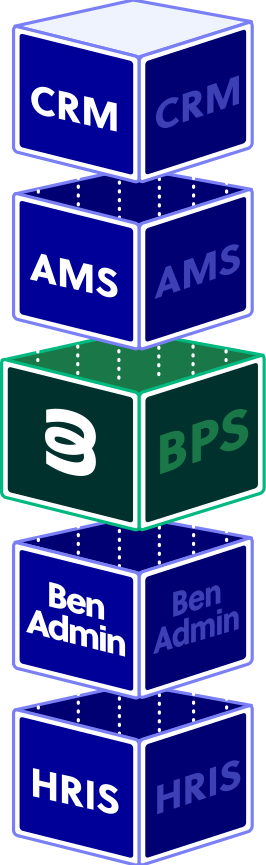
Account executives & producers
prospect and track opportunities and client activities.
(eg. Salesforce)
Account executives and account managers
update final plan designs and rates in AMS as their system of record
(eg. BenefitPoint, Zywave, Applied EPIC)
Benefit analysts, market analysts and placement specialists
easily renew, market, collaborate, analyze and negotiate with their carrier partners to place benefits with minimal data entry.
(eg. ThreeFlow)
Account executive, producers and implementation specialists
update final plan designs and rates to enable employees to make elections during open enrollment.
(eg. Ease, Employee Navigator)
HRIS coordinators confirm payroll deductions and
eligibility files to sync with BenAdmin systems.
(eg. Workday, Gusto, ADP, Rippling)
What changes when placement has a shared system of action
Brokers who use a BPS have a significantly lower volume of emails and spreadsheets to manage—all that placement work moves into one shared workspace. Beyond that, they:
- Make faster, more accurate decisions with real-time collaboration and a single source of truth. Brokers can compare, analyze, and recommend without second-guessing the data underneath.
- Gain full visibility into placement history and activity for all stakeholders. No one has to send a “just checking in” email—the data is all there.
- Finally have standardized, scalable workflows. Rather than reinventing the process for every client and every renewal, brokers can run consistent placement workflows that hold up whether they’re managing 20 employer groups or 200.
- Can reference an audit-ready quote history to see which brokers, carriers, and GAs changed what and when.
Why brokers and carriers are adopting shared systems of action now
Client expectations have never been higher. Employers are trying to match employee expectations while operating under tighter financial constraints, and as a result, brokers are under increasing pressure to explain tradeoffs and justify their recommendations.
As Nicole Negvesky, National Managing Director of Employee Benefits at The Baldwin Group puts it:
Trying to do that with disconnected tools isn’t easy. It’s why parts of the broker tech stack have already modernized. CRMs integrate with AMSs. Ben admin platforms pull data from carrier systems. A shared system of action brings placement into that connected ecosystem—without asking brokers to change how they work.
Placement works better when everyone works in the same place
A BPS provides that shared foundation, comfortably and at scale. Curious to see what that looks like?
Schedule time with one of our experts to see how ThreeFlow slots into your workflow to streamline placement and deliver better results.


JUMP TO SECTION
 How will this change the way we work?
Does it fit how we work today?
How does this platform protect my clients, my data, and my reputation?
Who is using your platform and how?
Will this software grow with us?
What truly sets this platform apart?
How does the pricing model align with our revenue model?
What happens after go-live?
How does the platform use AI right now?
How will this change the way we work?
Does it fit how we work today?
How does this platform protect my clients, my data, and my reputation?
Who is using your platform and how?
Will this software grow with us?
What truly sets this platform apart?
How does the pricing model align with our revenue model?
What happens after go-live?
How does the platform use AI right now?

%20(1).avif)